
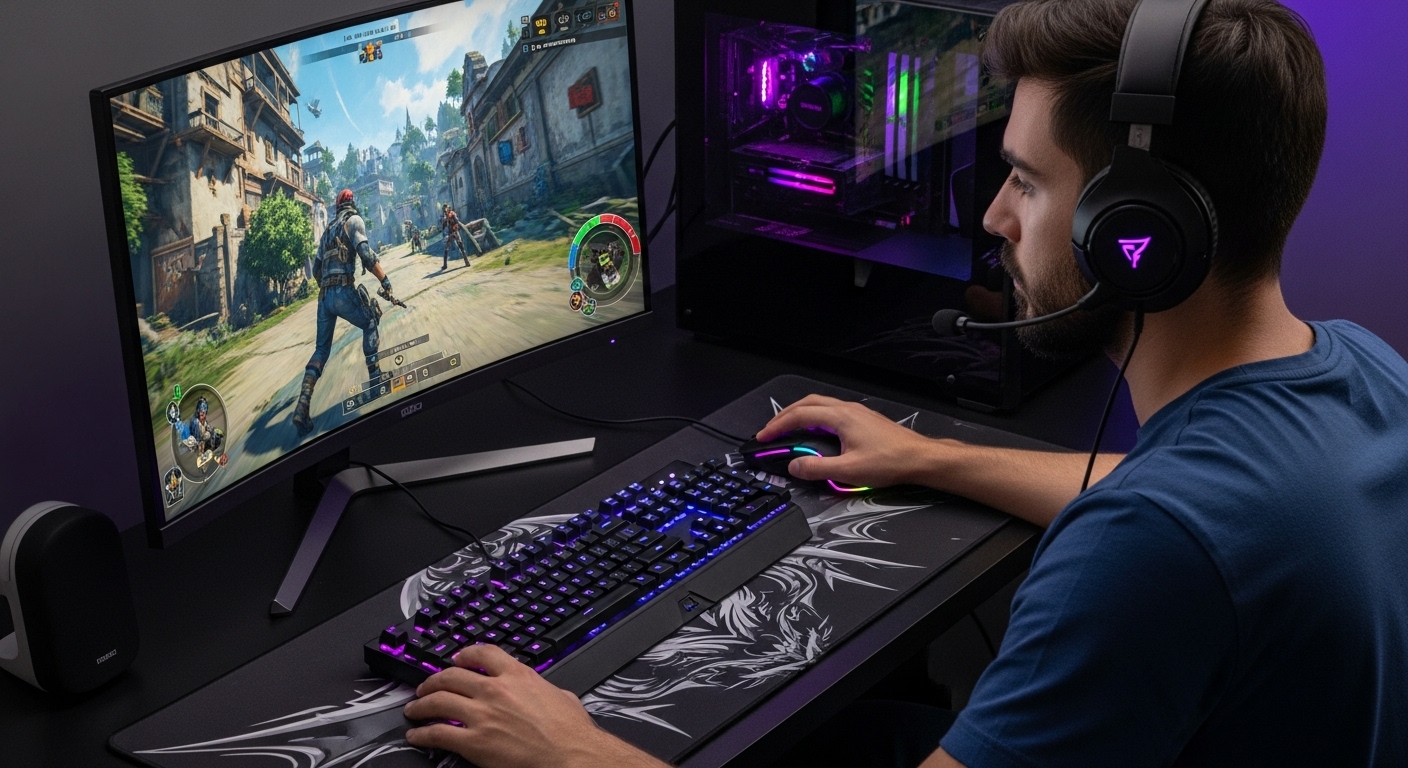
Video games have come a long way since their humble beginnings, evolving from simple pixelated displays on early arcade machines to the vast, immersive worlds we experience today. The gaming industry has undergone countless transformations, driven by technological advancements, shifts in consumer tastes, and cultural trends. This blog post takes an in-depth look at the evolution of video games, from their origins in the 1950s to their current state as a multi-billion-dollar global entertainment medium.
The Birth of Video Games: The 1950s to 1970s
The First Steps: Early Experiments and Arcade Games
While the term “video game” wasn’t even in common use until the 1970s, the first experiments that would eventually lead to the video game industry began in the late 1950s. In 1958, physicist William Higinbotham created one of the first interactive video games, Tennis for Two, using an oscilloscope to display the game on a screen. The game itself was a simple tennis simulation where two players used controllers to hit a ball back and forth, a concept that would become iconic in gaming history.
Around the same time, computer scientists at universities and research labs were experimenting with games for educational purposes, such as OXO (a variation of tic-tac-toe) and Spacewar! (a space combat simulation). These early games were only available on specialized machines and were played by a select group of individuals, mostly researchers and academics.
However, it wasn’t until the early 1970s that video games started to be commercialized and made available to the public. In 1972, Atari released Pong, one of the first arcade video games. Pong was simple, yet revolutionary. Players controlled paddles to bounce a ball back and forth, resembling a game of table tennis. The game became a massive success and is often regarded as the catalyst for the video game industry.
The Rise of Home Consoles
By the mid-1970s, the concept of home gaming consoles began to take shape. Magnavox Odyssey (1972) was one of the first home video game consoles, allowing players to enjoy simple games like Pong in their living rooms. However, it wasn’t until Atari’s release of the Atari 2600 in 1977 that home gaming started to reach a larger audience.
The Atari 2600 revolutionized gaming by introducing interchangeable game cartridges, which allowed players to purchase a wide variety of games. While the graphics and gameplay were still quite basic by today’s standards, the Atari 2600 set the foundation for the console gaming industry and helped video games move from arcade machines to homes around the world.
The Golden Age of Arcade Games: The 1980s
The Rise of Iconic Games
The 1980s marked a period of explosive growth for the video game industry, particularly in arcades. This era is often referred to as the “Golden Age” of arcade games, as it introduced some of the most iconic and influential titles in gaming history. Games like Space Invaders (1978), Pac-Man (1980), and Donkey Kong (1981) became cultural touchstones, drawing millions of players into arcades and helping establish video games as a mainstream form of entertainment.
Space Invaders was one of the first games to feature levels and high scores, which quickly became a standard feature in future arcade games. Pac-Man introduced a unique maze-chase mechanic that became widely recognized even outside of the gaming community. Pac-Man’s bright colors, catchy music, and non-violent gameplay attracted a diverse range of players, including women, who were not typically associated with gaming at the time.
The success of these early arcade titles led to the rapid growth of arcades in shopping malls, restaurants, and other public spaces. Video gaming became a social activity, where players would compete for high scores and challenge each other to beat difficult levels.
The Home Console Wars
The 1980s also saw fierce competition in the home console market. While Atari’s 2600 was the dominant home system in the late 1970s and early 1980s, it faced increasing competition from other consoles such as the Nintendo Entertainment System (NES), released in 1985, and the Sega Master System in 1986.
The NES was particularly significant because it revitalized the home console market after the video game crash of 1983, when poor-quality games and oversaturation led to a temporary collapse of the industry. Nintendo’s Super Mario Bros., released in 1985, became one of the most influential games of all time and solidified Nintendo’s place as a key player in the gaming world. The NES also introduced players to franchises like The Legend of Zelda and Metroid, which would become staples of the gaming industry.
The 1990s: 3D Graphics, Personal Computers, and Online Play
The Advent of 3D Graphics
The 1990s were a pivotal decade for gaming, as new technologies allowed for the creation of fully 3D environments. While 2D side-scrollers and top-down shooters had dominated earlier generations of gaming, the introduction of 3D graphics opened up new possibilities for game design, storytelling, and player immersion.
In 1991, Super Mario 64 was released for the Nintendo 64. This groundbreaking game was one of the first to offer a true 3D world for players to explore. It featured an open-world design, where players could control Mario as he navigated through vast, multi-dimensional environments. The game’s innovative use of 3D camera control and platforming mechanics became the foundation for future 3D platformers.
Other consoles, like the Sony PlayStation (released in 1994), also embraced 3D graphics, offering players a new level of realism and depth. Final Fantasy VII, released in 1997 for the PlayStation, featured detailed 3D character models and rendered environments, setting a new standard for the role-playing game (RPG) genre.
The Rise of Personal Computers and the Internet
The 1990s also saw the rise of personal computers as gaming platforms. With the growing popularity of PCs, games like Doom (1993) and Warcraft (1994) helped define the genre of first-person shooters and real-time strategy games. The Doom series, in particular, played a major role in popularizing online multiplayer gaming. Players could connect over local area networks (LANs) to compete in virtual arenas, paving the way for modern online gaming.
The internet revolutionized the way games were played and distributed. Early multiplayer games like Quake (1996) and StarCraft (1998) allowed players to connect with others around the world and compete in real-time. This laid the groundwork for the massive online gaming communities we have today.
The Emergence of MMORPGs
The 1990s also saw the birth of the massively multiplayer online role-playing game (MMORPG) genre. Games like Ultima Online (1997) and EverQuest (1999) allowed players to interact in vast, persistent worlds with thousands of other players. These games introduced concepts such as character progression, guilds, and virtual economies, which would become central to the MMORPG genre for years to come.
The success of MMORPGs in the late 1990s foreshadowed the rise of World of Warcraft in the early 2000s, which would go on to become one of the most successful and influential video games in history.
The 2000s: Mobile Gaming, HD Graphics, and Online Communities
The Rise of High-Definition Gaming
As technology advanced in the 2000s, video games began to feature high-definition (HD) graphics, bringing an unprecedented level of detail and realism to gaming. The PlayStation 2 (released in 2000) and the Xbox 360 (released in 2005) ushered in the era of HD gaming, allowing for more sophisticated visuals, complex game mechanics, and expansive game worlds.
Titles like The Elder Scrolls IV: Oblivion (2006), Grand Theft Auto IV (2008), and Halo 3 (2007) showcased the capabilities of next-gen consoles, offering players more detailed and realistic environments, more advanced AI, and more immersive experiences.
Mobile Gaming Explosion
The 2000s also saw the rise of mobile gaming, largely thanks to the release of smartphones like the Apple iPhone. With the launch of the App Store in 2008, mobile gaming became accessible to millions of people around the world. Titles like Angry Birds (2009) and Candy Crush Saga (2012) became global phenomena, showing that gaming could thrive on mobile devices.
Mobile gaming has played a significant role in expanding the gaming audience, attracting casual gamers who may have never considered traditional console gaming. The rise of free-to-play mobile games and microtransactions also introduced new business models to the gaming industry.
The Emergence of Online Communities and eSports
The 2000s also saw the rise of online gaming communities and the growth of competitive gaming. Platforms like Steam and Xbox Live allowed players to connect with others around the world, forming vibrant online communities. Games like Call of Duty 4: Modern Warfare (2007) and World of Warcraft (2004) became staples of online multiplayer gaming, with players teaming up or competing for dominance in virtual worlds.
At the same time, competitive gaming, or eSports, began to gain mainstream attention. Professional gaming leagues and tournaments began to emerge, with games like StarCraft II and League of Legends drawing huge crowds and offering multi-million-dollar prize pools. Platforms like Twitch allowed gamers to stream their gameplay live, giving rise to a new generation of gaming celebrities and content creators.
The 2010s: Virtual Reality, Streaming, and the Future of Gaming
Virtual Reality: The Next Frontier
The 2010s introduced the next big step in gaming technology: virtual reality (VR). While VR had been a concept in gaming for decades, it wasn’t until the release of devices like the Oculus Rift (2016) and PlayStation VR (2016) that the technology became accessible to consumers. VR gaming allowed players to immerse themselves in fully realized 3D worlds, offering a more visceral and interactive experience than traditional gaming.
Games like Beat Saber (2018) and Half-Life: Alyx (2020) showcased the potential of VR, offering players a chance to engage with their environments in entirely new ways. However, despite the excitement surrounding VR, its adoption has been slower than expected due to high costs and technical limitations.
Streaming and the Rise of Game Distribution Platforms
Game streaming and digital distribution platforms like Steam, Epic Games Store, and Google Stadia became central to how players accessed and played games in the 2010s. These platforms allowed gamers to download and play titles without needing physical discs, offering a more convenient and cost-effective way to access games.
Streaming also became an integral part of the gaming experience, with platforms like Twitch and YouTube Gaming giving players a platform to share their gameplay with others. The rise of live-streamed gaming has changed the way people consume entertainment, with some gamers becoming celebrities with millions of followers.
eSports and Competitive Gaming
eSports continued its meteoric rise in the 2010s, with games like League of Legends, Overwatch, and Fortnite gaining massive popularity in competitive gaming circles. eSports tournaments became multimillion-dollar events, with millions of viewers tuning in online to watch professional gamers battle it out for glory.
The growth of eSports has also led to the establishment of college scholarships for competitive gaming, professional gaming teams, and major corporate sponsorships, making gaming a legitimate career path for skilled players.
Conclusion: The Future of Video Gaming
The world of video gaming has evolved dramatically over the past several decades, from its humble beginnings as an academic experiment to becoming one of the most lucrative forms of entertainment. As technology continues to advance, it’s clear that gaming will continue to push boundaries in terms of storytelling, immersion, and player interaction. Whether through the rise of virtual reality, the continued growth of eSports, or the expansion of mobile gaming, the future of video games is bound to be even more exciting than its past.
As we look to the future, it’s impossible to predict all the ways in which gaming will continue to shape our culture. One thing is certain, though: video games are here to stay, and they are only going to become more innovative, immersive, and influential in the years to come.